

You finally decided to ask about medication. Then you opened a search bar and hit a wall of letters: LCSW, DO, PMHNP-BC.
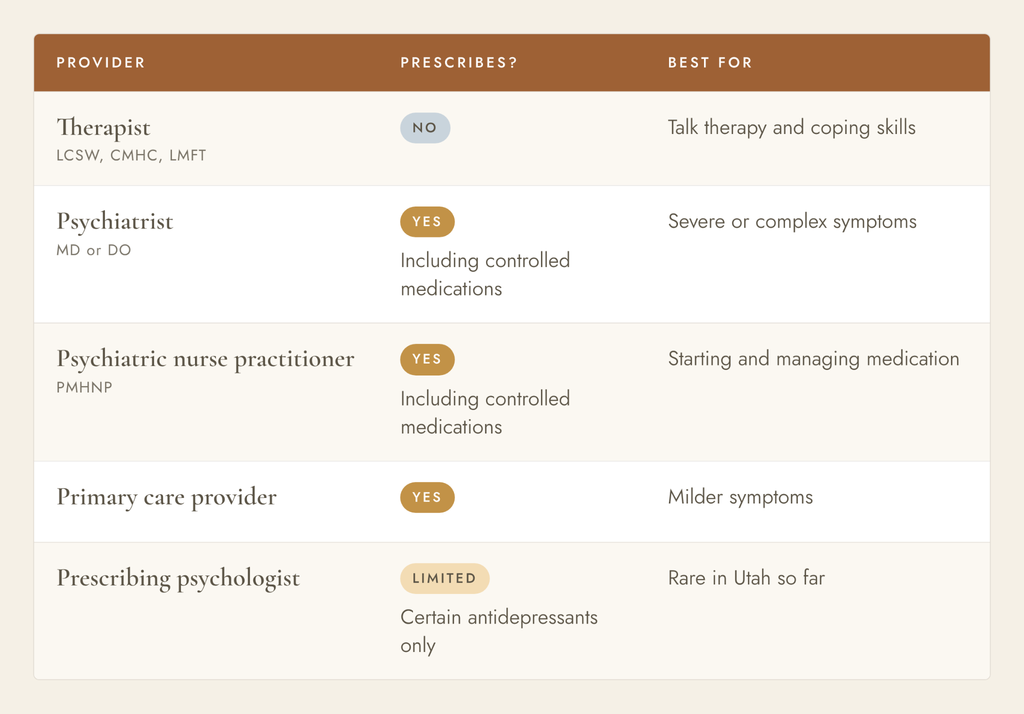
Who can prescribe mental health medication? Psychiatrists, psychiatric nurse practitioners (PMHNPs), and primary care providers can all prescribe it. Therapists and counselors cannot. In Utah, a small number of specially certified psychologists can also prescribe a limited set of psychiatric medications. Many people do best seeing a therapist and a prescriber at the same time.
Most people assume they need to pick the right kind of provider before they reach out. That belief keeps a lot of people stuck on the search page for weeks. The title matters less than the service you need: talk therapy, a medication evaluation, or both. This guide is for Utah adults and parents making that call for themselves or someone they love.
Why This Feels So Confusing
Mental health care is split across several license types, and the titles overlap. “Counselor,” “therapist,” and “clinician” can all describe the same person, while two very different providers can both go by “doctor.” No wonder people freeze before booking.
Start with the service you need, not the title
Name the service first. If you want someone to talk with and learn skills from, you are looking for therapy. If you want to know whether medication could help, you are looking for a medication evaluation, the first step in medication management. Then the letters tell you who offers what:
- LCSW, CMHC, LMFT: Licensed Clinical Social Worker, Clinical Mental Health Counselor, and Licensed Marriage and Family Therapist. These are therapy licenses, and none include prescribing.
- DO or MD: A physician. Both can prescribe, and a psychiatrist is a physician who completed residency training in psychiatry.
- PMHNP-BC: A board-certified Psychiatric Mental Health Nurse Practitioner, an advanced practice nurse who can evaluate, diagnose, and prescribe.
This article is for informational purposes and is not a substitute for professional diagnosis or treatment. If you are in crisis, call or text 988 or dial 911.
What Each Type of Provider Does
Each provider type plays a different role, and the roles are meant to fit together. Here is what each one does when it comes to medication.
Therapists, counselors, and social workers
Therapists provide talk therapy. They help you understand patterns, build coping skills, and work through what is weighing on you, using approaches like CBT, EMDR, or DBT. In Utah, therapists cannot prescribe, adjust, or stop medication.
What a therapist can do is notice when symptoms may be a sign that medication is worth discussing. They can refer you to a prescriber and, with your permission, share what they see so your prescriber gets the full picture. For more on how therapists and psychologists differ, see our guide to therapists, psychologists, and psychiatric nurse practitioners.
Psychiatrists
A psychiatrist is a medical doctor (MD or DO) who completed medical school and a psychiatry residency. Psychiatrists diagnose mental health conditions, prescribe medication, and manage complex cases. Some also provide therapy, though many focus on medication. A psychiatrist is often the right fit when symptoms are severe, when several conditions overlap, or when a physical health condition complicates medication choices.
Psychiatric Mental Health Nurse Practitioners (PMHNPs)
A PMHNP is a registered nurse with a graduate degree in psychiatric mental health nursing. The “BC” means board certified in that specialty. PMHNPs evaluate symptoms, diagnose, prescribe, and follow up with you over time. In Utah, nurse practitioners have full practice and prescribing authority without physician supervision, and under Utah Code § 58-31b-803 that authority includes Schedule II through V controlled substances, such as ADHD stimulants.
How do PMHNPs compare to psychiatrists? For most day-to-day medication management, like starting or adjusting an antidepressant, both provide the same core service. The main difference is the training path: medical school and residency for psychiatrists, nursing and a specialty graduate program for PMHNPs. For especially complex situations, a PMHNP may consult with or refer to a psychiatrist.
Where your primary care provider fits
Your family doctor or primary care nurse practitioner can prescribe many common mental health medications, including antidepressants. For milder anxiety or depression, starting there can make sense, especially if you already trust that provider. A psychiatric prescriber may be a better fit if the first medication does not help, if side effects are hard to manage, or if symptoms are getting worse.
Who Can Prescribe Medication
In Utah, psychiatrists, psychiatric nurse practitioners, primary care physicians, other nurse practitioners, and physician assistants can prescribe mental health medication. Therapists cannot.
Utah’s 2024 law, SB 26, also lets specially certified psychologists prescribe, but that authority is narrow. According to Utah’s Office of Professional Licensure Review explainer on SB 26, a prescribing psychologist may prescribe SSRIs, a common class of antidepressants, must keep a collaborative relationship with the patient’s primary care provider, and may not prescribe controlled substances.
Yes. For most non-controlled medications, such as common antidepressants, a telehealth appointment works much like an in-person one. The prescriber generally needs to be licensed in the state where you are during the visit.
Can online providers prescribe medication, including controlled substances?
Controlled substances, such as ADHD stimulants and some anxiety medications, follow stricter federal rules that normally require an in-person exam first. However, the DEA and the Department of Health and Human Services extended temporary telemedicine flexibilities through December 31, 2026. Until then, DEA-registered prescribers can prescribe Schedule II through V medications over video without an in-person visit.
These rules may change in 2027. The DEA sent a permanent telemedicine rule for White House review in August 2026, and it had not been published as of this writing. Aspen offers teletherapy anywhere in Utah, and your prescriber can explain how the current rules apply to you.
Where prescriptions usually go
Most prescriptions are sent electronically to the pharmacy you choose, whether that is a local pharmacy or a mail-order option through your insurance. Refills come from your prescriber, not your therapist. Some medications need your insurer’s approval first, called prior authorization, which can add a few days.
Do I Need Medication?
Only a prescriber can answer that, after an evaluation, and you always get a say. Medication is common: in 2024, 19.3% of U.S. adults took prescription medication for their mental health, according to a June 2026 data brief from the CDC’s National Center for Health Statistics. That is roughly one in five adults.
Should I start with therapy or medication management?
For many people, therapy is a good place to start, especially when symptoms are milder. A 2024 network meta-analysis of 100 trials published in Acta Neuropsychiatrica found that adding medication to therapy worked better than therapy alone for moderate to severe depression. For mild depression, the researchers did not see that difference.
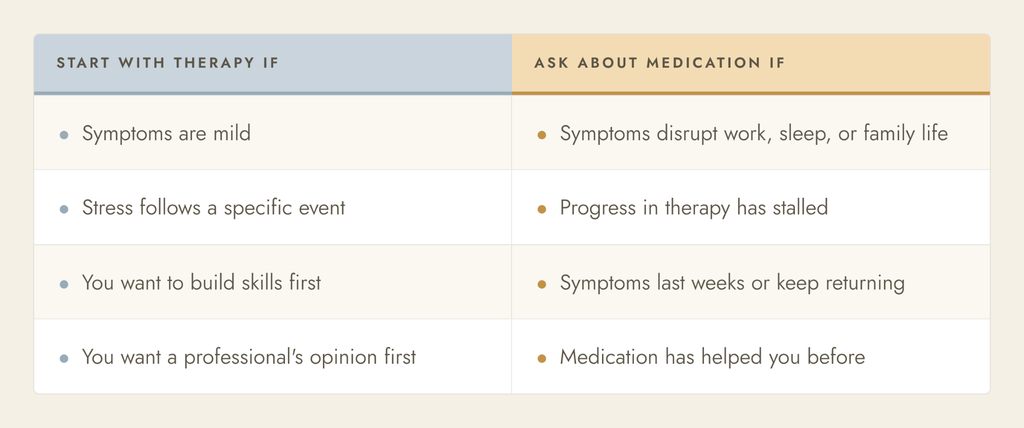
Still unsure? A Client Care Specialist can help you pick a starting point, and you can add the other service later.
Common worries about starting medication
Worries about medication are normal, and a good prescriber will welcome them.
- “Will it change who I am?” Medication aims to ease symptoms, not change your personality. If you feel flat or unlike yourself, tell your prescriber, because an adjustment often helps.
- “Will I get addicted?” Most antidepressants are not habit-forming. Some anxiety and sleep medications carry more risk, and your prescriber should explain this before you start.
- “Does needing medication mean I failed?” No. Medication works a bit like a cast on a broken arm: it supports healing while you do the work of recovery.
Why Therapy and Medication Often Work Better Together
Therapy and medication do different jobs. Medication can ease symptoms enough that you have energy to engage. Therapy helps you build skills, change patterns, and handle what comes next.
Research supports pairing them. A 2026 network meta-analysis in Psychotherapy and Psychosomatics pooled 94 trials involving 23,874 adults with depression. Combined therapy and medication produced the largest improvement in daily functioning, including work, relationships, and time with others. Therapy alone and medication alone performed about the same as each other.
Can I see a therapist and a prescriber at the same time?
Yes, and many people do. Your therapist and prescriber can work in the same practice or different ones. Seeing both in one practice often makes communication simpler, because your care team already knows each other.
How your providers coordinate care (consent and sharing information)
The federal privacy law known as HIPAA allows providers to share mental health information for treatment. Even so, many offices ask you to sign a release of information, especially when your providers work at different organizations. You can ask what will be shared and set limits. A therapist’s separate, detailed session notes, called psychotherapy notes, have extra HIPAA protection and generally require your written permission to share.
Good coordination is simple: your therapist shares what they notice, your prescriber shares medication changes, and you stay in the loop.
What to Expect From Medication Management
Medication management is the ongoing process of starting, monitoring, and adjusting medication with a prescriber. It begins with an evaluation and continues with shorter follow-up visits.
Your first medication appointment and what you leave with
Your first medication appointment is usually the longest. Expect questions about symptoms, past treatment, physical health, family history, sleep, and substance use. It helps to bring:
- A list of current medications and supplements, with doses
- Past mental health medications and how they worked for you
- Your therapist’s name, if you want your providers to coordinate
- Your insurance card and preferred pharmacy
Can you get medication at your first appointment? Sometimes. If a medication fits and you agree, many people leave with a prescription sent to their pharmacy. Other times the prescriber orders lab work or requests past records first, which is more common with ADHD medications or complex histories. Either way, you should leave with a plan and a follow-up date.

What good medication management should feel like
Good medication management feels collaborative, not rushed. Many antidepressants take several weeks to reach their full effect, so early follow-ups often focus on side effects and small adjustments. Signs you are in good hands:
- Your prescriber explains why they recommend a specific medication and what else they considered.
- You hear about likely side effects and what to do if they show up.
- You know when your next visit is and how to reach the office in between.
- Changes happen gradually, and each one gets checked.
- Your questions and hesitations are taken seriously.
- With your consent, your prescriber and therapist stay on the same page.
- You talk about the long-term plan, including whether and when to taper off.
When to Seek Professional Help
It may be time to reach out when symptoms start shaping your days instead of passing through them. In daily life, that can look like:
- Lying awake most nights, or sleeping far more than usual
- Dreading work or school, or falling behind in ways that are new for you
- Pulling away from people or activities you used to enjoy
- Feeling on edge, irritable, or tearful more days than not
- Panic or a tight chest that keeps coming back
- Leaning on alcohol or other substances to get through the day
If any of these have lasted two weeks or more, or keep returning, they may be a sign it is worth talking with a professional. You don’t need a diagnosis before you call. Our page on anxiety and depression treatment explains how therapy helps with the most common reasons people reach out.
Aspen Counseling Services offers therapy and medication management in one practice, with offices in Sandy, Highland, and Provo and teletherapy anywhere in Utah. Our prescribers, Dr. Frances Liu, DO, and Justin Mathews, PMHNP-BC, work alongside our therapists so your care stays connected. You can meet our therapists before you reach out.
Call or text 801-449-0017 to talk with a Client Care Specialist about whether therapy, medication management, or both is the right place to start.
When to Seek Emergency Support
If you are thinking about suicide or are in emotional crisis, call or text 988 to reach the 988 Suicide and Crisis Lifeline, any time of day or night. If you or someone else is in immediate danger, call 911 or go to the nearest emergency room.
Outpatient practices, including Aspen, are not crisis services. Getting emergency help first is the right step, and you can connect with ongoing care afterward. If a new medication brings on thoughts of harming yourself, call or text 988 and tell your prescriber as soon as you can.
Frequently Asked Questions
Can a therapist prescribe medication?
No. In Utah, therapists, counselors, and social workers, including LCSWs, CMHCs, and LMFTs, cannot prescribe medication. Their licenses cover assessment and talk therapy. A therapist can notice when medication may be worth discussing, refer you to a prescriber, and coordinate with that prescriber if you give permission. Utah’s 2024 prescribing psychologist law does not apply to therapists. It covers only licensed psychologists with additional certification, and even they cannot prescribe controlled substances.
Is a PMHNP the same as a psychiatrist?
No, though the care can feel similar. Both evaluate symptoms, diagnose, prescribe, and manage medication over time, and in Utah both can prescribe controlled medications. A psychiatrist is a physician who completed medical school and a psychiatry residency. A PMHNP is an advanced practice nurse with graduate training in psychiatric mental health care. Psychiatrists are often involved in the most complex cases, while a board-certified PMHNP is a well-trained option for starting and adjusting common medications.
Can my primary care doctor prescribe mental health medication?
Yes. Primary care physicians, nurse practitioners, and physician assistants can prescribe many mental health medications, including common antidepressants, and many people start there. Primary care can work well for milder, straightforward symptoms. If symptoms are severe, the first medication does not help, or side effects are hard to manage, ask about a referral to a psychiatric prescriber. Your primary care provider can stay involved alongside the specialist.
Will I have to take medication forever?
Not necessarily. How long you take medication depends on your symptoms, your history, and how you respond. Some people take it for a defined period while building skills in therapy, then taper off with their prescriber’s guidance. Others with long-term or recurring conditions stay on it longer. Never stop a medication suddenly on your own, because stopping abruptly can cause uncomfortable effects or a return of symptoms.
Can I do therapy and medication management online at the same time?
Yes. Both can happen over secure video, and many people combine them. For most non-controlled medications, telehealth prescribing works much like an in-person visit. Federal rules allowing controlled medications to be prescribed by telehealth are extended through December 31, 2026, with a permanent rule still pending. You generally need to be in a state where your providers are licensed during each session, and Aspen’s teletherapy is available anywhere in Utah.
Disclaimer and Crisis Line
This article is for informational purposes and is not a substitute for professional diagnosis or treatment. If you are in crisis, call or text 988 or dial 911.