

Maybe you have felt flat for weeks and keep calling it a busy season.
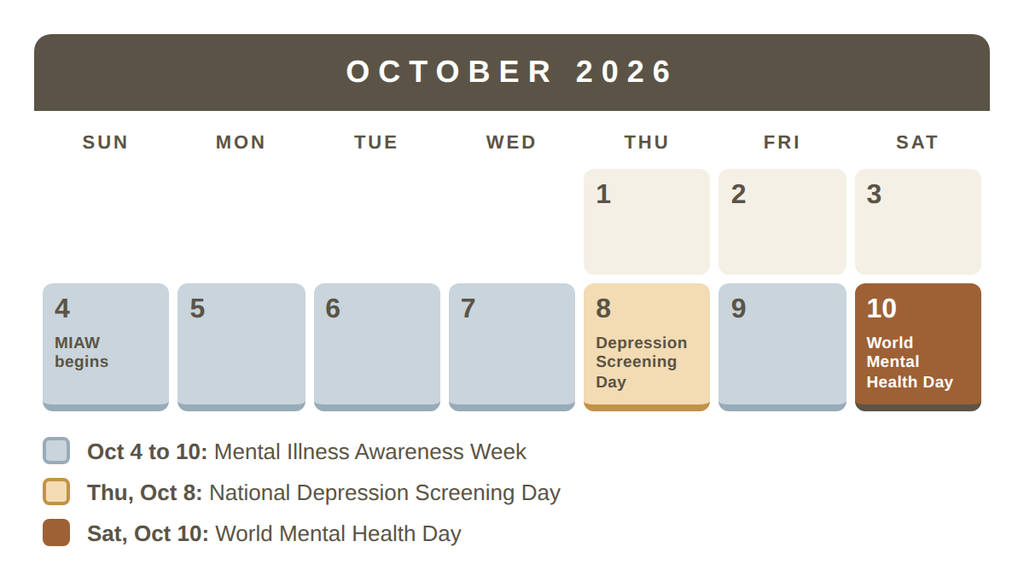
Mental Illness Awareness Week is a national observance held the first full week of every October. In 2026, it runs Sunday, October 4 through Saturday, October 10. The week includes National Depression Screening Day on Thursday, October 8, and ends on World Mental Health Day. Its goal is simple: help people notice mental health challenges and find support.
Many people assume awareness weeks are for someone else, like someone with a diagnosis or someone in crisis. But this week is for everyone. That includes the parents in Highland, the BYU students in Provo or UVU students in Orem, and the professional in Sandy who keeps saying they are fine.

If something has felt off lately, you can call or text our Client Care team at 801-449-0017 just to ask questions. You do not have to know what kind of help you need yet.
If you or someone else is in danger right now
- Call or text 988 to reach the 988 Suicide and Crisis Lifeline, available 24 hours a day.
- Call 911 or go to the nearest emergency room if someone is in immediate physical danger.
Key takeaways
- Mental Illness Awareness Week 2026 runs October 4 to 10, with National Depression Screening Day on October 8 and World Mental Health Day on October 10.
- A depression screening is a short questionnaire that flags possible symptoms. It is a starting point, not a diagnosis.
- Substance Abuse and Mental Health Services Administration’s (SAMHSA) 2025 national survey found that about 1 in 5 U.S. adults had a mental illness in the past year.
- In Utah, support is available by phone, in person in Sandy, Highland, and Provo, and by teletherapy anywhere in the state.
What Is Mental Illness Awareness Week?
Mental Illness Awareness Week (MIAW) has been observed since 1990, when Congress set aside the first full week of October following advocacy by the National Alliance on Mental Illness. NAMI describes the week as a time for communities to raise awareness, fight stigma, and support mental health.
Mental Illness Awareness Week is a reminder that anxiety, depression, and other conditions are health issues, and that asking about them is normal. Three observances overlap in the same week:
What Is National Depression Screening Day?
National Depression Screening Day is held on the Thursday of Mental Illness Awareness Week. It encourages people to take a short, confidential questionnaire about mood, sleep, energy, and interest in daily life.
A depression screening works a lot like a blood pressure check at the pharmacy. A high reading does not mean you have heart disease. It means the number is worth a closer look with someone trained to interpret it. A depression screening does the same job for your mood.
Screening has strong national support. In 2023, the U.S. Preventive Services Task Force recommended depression screening for all adults, including pregnant and postpartum people and older adults. The panel added that anyone who screens positive should get a fuller evaluation and, if appropriate, care.
A screening and an evaluation do different jobs. A screening is a short set of questions about recent symptoms. It tells you whether symptoms may be present, so you can decide whether to talk to someone. An evaluation is a longer conversation with a clinician about your history, symptoms, and goals. It helps you understand what is going on and what may help, and it ends with a plan you build together.
What should you do with your screening results?
If a screening suggests symptoms of depression, it may be worth talking to a therapist soon. If it does not, but you still do not feel like yourself, that counts too. How you feel day to day matters more than any score.

Why Does Mental Health Matter in Utah?
Mental health challenges are among the most common health conditions in the country. SAMHSA’s 2025 National Survey on Drug Use and Health, released in July 2026, found that 20.6% of U.S. adults, about 54.6 million people, had a mental illness in the past year. The same survey found that 18% of teens ages 12 to 17 had moderate or severe anxiety symptoms in the two weeks before they were surveyed.
Utah’s numbers run higher than most. Mental Health America’s 2024 State of Mental Health in America report placed Utah highest among states for adult mental illness, at about 29% of adults.
Numbers like these do not mean something is wrong with you. They mean you are far from the only one in your neighborhood, your office, or your carpool who is quietly struggling.
What Should You Know About Mental Health Challenges?
- They are common and real. Anxiety and depression are health conditions, not character flaws or a lack of effort.
- They often show up in the body first. A tight chest, a knotted stomach, or lying awake at 11pm can all be part of the picture.
- Earlier support tends to be easier. SAMHSA notes that beginning treatment earlier is linked with a greater likelihood of a better outcome.
- You do not need to know what therapy you need. You do not have to know what CBT or EMDR is before you call.
- Finding the right therapist matters. Fit makes a difference, and switching therapists is completely fine.
Resources for Individuals in Need of Assistance
Help looks different depending on how urgent things feel. Mental health resources in Utah range from 24/7 crisis lines to ongoing counseling.
If you or someone else is in danger right now
- Call or text 988 to reach the 988 Suicide and Crisis Lifeline, available 24 hours a day.
- Call 911 or go to the nearest emergency room if someone is in immediate physical danger.
If you need support but it is not an emergency
- NAMI HelpLine: Call 800-950-6264 or text “HelpLine” to 62640, Monday through Friday, 10am to 10pm Eastern. NAMI also offers a Spanish-language HelpLine.
- Your primary care provider: Ask for a depression screening at your next visit.
- Aspen Counseling Services: We offer support for anxiety and depression, medication management with our prescribers, and Spanish-speaking clinicians. We accept most major insurance plans.
For more ways to start the conversation with the people around you, read our guide to increasing mental health awareness.
Use This Week as Your Check-In
Mental Illness Awareness Week only asks one thing of you: notice how you are really doing. If the answer is “not great,” you don’t have to face it alone.
Our Client Care Specialists will ask a few questions, learn what you are looking for, and match you with a therapist who fits. You can meet in our Sandy, Highland, or Provo offices, or use teletherapy from anywhere in Utah, even from your car on a lunch break.
Call or text 801-449-0017 to be matched with a therapist this week.

Frequently Asked Questions
When is Mental Illness Awareness Week 2026?
Mental Illness Awareness Week 2026 runs from Sunday, October 4 through Saturday, October 10. It always falls during the first full week of October. National Depression Screening Day is on Thursday, October 8, and World Mental Health Day is on Saturday, October 10. Many schools, clinics, and community groups across Utah hold events or share resources during the week.
Is Mental Illness Awareness Week the same as Mental Health Awareness Week?
No. Mental Illness Awareness Week is a U.S. observance held each October. Mental Health Awareness Week is a separate United Kingdom observance held in May, and the United States marks Mental Health Awareness Month every May. All three aim to reduce stigma and help people find care, as our guide to Mental Health Month and why it matters explains.
Does a positive depression screening mean I have depression?
No. A depression screening is a short questionnaire that flags symptoms worth a closer look. Only a licensed clinician can diagnose depression, usually after a longer conversation about your history and how you have been feeling. A positive screening simply means it may be worth talking to someone.
How do I know if it is time to talk to a therapist?
It may be time to talk to someone when difficult feelings stick around, or when they get in the way of work, school, sleep, or relationships. You do not need to be in a crisis to start therapy. Many people come in because they feel stuck, tired, or not like themselves.
Last reviewed: September 2026
This article is for informational purposes and is not a substitute for professional diagnosis or treatment. If you are in crisis, call or text 988 or dial 911.